

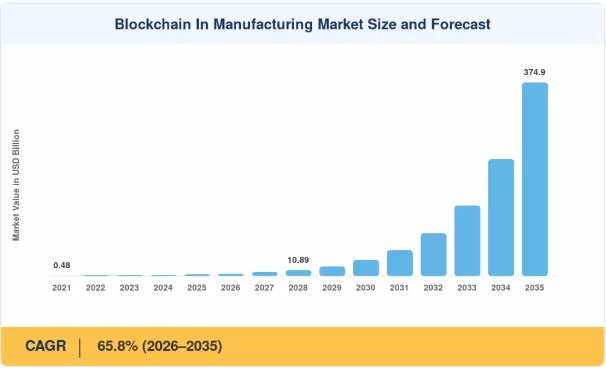
Blockchain in Manufacturing Market Expected to Achieve USD 374.9 Billion by 2035 Through a Robust 65.8% CAGR
Blockchain in Manufacturing Market
Blockchain in Manufacturing Market Size, Share and Research Report By Application Area (Supply Chain Management, Quality Control, Inventory Management)
Blockchain in Manufacturing Market: Blockchain adoption is enhancing manufacturing supply-chain transparency, traceability, security, and operational efficiency.”
BERLIN, BERLIN, GERMANY, September 1, 2026 /EINPresswire.com/ -- The Global Blockchain in Manufacturing market closed 2025 at USD 2.39 billion, opens the forecast window at USD 3.96 billion in 2026, and is projected to reach USD 374.9 billion by 2035 at a 65.8% CAGR across 2026-2035. Two catalysts explain the steepness. Regulation (EU) 2024/1781, the Ecodesign for Sustainable Products Regulation, entered into force in July 2024 and created the legal basis for Digital Product Passports across priority industrial categories. In parallel, US Drug Supply Chain Security Act obligations pushed pharmaceutical manufacturers toward interoperable, electronic, item-level traceability. — Market Research Future (MRFR)
The market's expansion reflects the convergence of Digital Product Passport mandates under ESPR (~14.2% impact), counterfeit component losses in electronics and aerospace (~11.8%), pharmaceutical serialization enforcement under DSCSA (~10.4%), and battery and critical-mineral traceability obligations (~9.6%) accelerating across the world's largest regulatory-compliance and industrial-export economies simultaneously.
Blockchain in manufacturing refers to the use of distributed ledger technology to securely record and share information across manufacturing ecosystems. Instead of relying on isolated databases maintained by individual organizations, blockchain can provide participating parties with a common, verifiable record of transactions and events.
Its applications extend from raw-material sourcing and procurement to production, quality assurance, logistics, asset management, product authentication, warranty management, and regulatory compliance. Research published in 2026 also highlights blockchain readiness as an important component of broader Industry 4.0 transformation.
Get Full PDF Sample Copy of Report: (Including Full TOC, List of Tables & Figures, Chart) @
https://www.marketresearchfuture.com/sample_request/32401
➤ How Significant Is the Blockchain in Manufacturing Market's Growth?
The blockchain in manufacturing market's trajectory from USD 2.39 billion in 2025 to a projected USD 374.9 billion by 2035 represents more than a 150-fold expansion over the forecast decade, reflecting the structural shift from paper certificates of analysis and single-tenant MES and ERP quality records toward permissioned distributed ledgers, verifiable credentials, and shared event schemas that make provenance claims cryptographically auditable. The market's 65.8% CAGR is anchored in a compliance-and-fraud supercycle where Digital Product Passport mandates, counterfeit component exposure, and pharmaceutical serialization enforcement are all converging to make ledger-anchored provenance a regulatory prerequisite rather than a discretionary efficiency initiative.
Private and permissioned ledgers command 58.7% of the market in 2025, reflecting confidentiality requirements on shop-floor pricing and volume data, while cloud and Blockchain-as-a-Service deployment reached USD 1.30 billion in 2025 as hyperscalers absorb the node-operations burden that killed early projects, and hybrid and edge architectures are expanding at a 73.1% CAGR, the fastest of any deployment mode.
By application, logistics and supply chain management leads with 41.6% share, reflecting multi-tier visibility needs no single participant could previously satisfy, while counterfeit management is the fastest-growing application at a 69.4% CAGR as a single fake component in a flight-critical assembly can trigger a fleet-wide inspection costing more than a decade of platform subscription. By end-user vertical, automotive leads at 26.4% share through battery passport obligations, while aerospace and defense grows fastest at a 67.9% CAGR on parts-provenance and counterfeit-electronics mandates.
➤ Major Applications:
Logistics and Supply Chain Management: Supply-chain management is one of the most significant application areas. Blockchain can provide a shared record of shipments, transactions, material provenance, and delivery events, helping organizations improve visibility and coordinate activities.
Business Process Optimization: Manufacturers can use blockchain to automate selected procurement, contracting, payment, warranty, and supplier-management processes.
Asset Tracking: Blockchain can maintain records associated with industrial assets, components, equipment, and products throughout their lifecycle. This can be particularly useful when multiple organizations interact with the same asset.
Counterfeit Management: Digital records can help manufacturers and customers verify the provenance and authenticity of products and components.
Quality Control: Blockchain can link quality inspections, certifications, production events, and component histories to create a more complete record of product quality.
➤ Emerging Trends:
Blockchain With AI: Manufacturers are increasingly combining advanced technologies rather than deploying them independently. AI can analyze manufacturing and supply-chain data, while blockchain can provide trusted records for selected transactions and data exchanges. The broader manufacturing sector is already moving toward enterprise-wide AI, advanced analytics, and stronger data foundations, creating an environment in which blockchain can potentially complement other digital technologies.
Digital Product Passports and Provenance: Growing interest in sustainability, circular manufacturing, and product provenance is creating opportunities for blockchain-based digital records that document a product's materials, origin, lifecycle events, and ownership history.
Sustainable Supply Chains: Blockchain can support sustainability reporting by improving the traceability of information across supply chains. However, blockchain implementations themselves must consider computational requirements and energy consumption, particularly for large networks and high transaction volumes.
Permissioned Blockchain Networks: Enterprise manufacturers are likely to favor controlled networks where participants are identified and access rights can be managed. This approach can provide the benefits of distributed records while addressing commercial confidentiality and governance requirements.
Get access to the full description of the report @
https://www.marketresearchfuture.com/reports/blockchain-in-manufacturing-market-32401
➤ Who Are the Key Players in the Blockchain in Manufacturing Market?
Concentration in the blockchain in manufacturing market sits in the moderate band. Estimated top-five combined share falls between 39% and 44%, with a Herfindahl-Hirschman Index in the 580-660 range, fragmented enough that no vendor dictates standards, concentrated enough that hyperscaler platform choices shape architecture for everyone else. Systems integrators capture a disproportionate share of total project value relative to platform licensing, which is why several specialists position around vertical depth rather than infrastructure. MRFR identifies the following key participants with estimated revenue share ranges:
IBM (~11–14% share) - the deepest vertical consulting bench, rebuilding credibility post-TradeLens, providing enterprise permissioned ledger platforms and food and parts traceability solutions, positioned across food, automotive, and aerospace provenance deployments.
Microsoft (~9–12% share) - a provider that wins on existing enterprise cloud footprint, offering Azure-hosted ledger services and identity and verifiable credential tooling, leveraging its broader cloud installed base to capture manufacturing traceability workloads.
Amazon Web Services (~7–10% share) - an infrastructure-first provider light on manufacturing domain depth, offering managed ledger and immutable-log services, positioned to serve customers seeking hyperscaler-grade node-operations abstraction.
SAP (~6–9% share) - strongest where the ERP is already SAP, offering ERP-embedded traceability and compliance extensions, converting existing enterprise resource planning relationships into ledger-adjacent compliance revenue.
Oracle (~5–8% share) - a database-adjacent positioning specialist strong in process industries, offering a blockchain platform integrated with supply-chain cloud applications, serving customers already anchored to Oracle's broader database ecosystem.
Accenture (~5–7% share) - the largest implementation practice, platform-agnostic, providing consortium design, integration, and managed operations, positioned to serve customers regardless of underlying ledger technology choice.
Siemens (~3–5% share) - a provider that owns the shop-floor layer competitors must integrate with, providing industrial data spaces and digital twin and provenance linkage, anchoring much of the industry's manufacturing-execution-layer integration.
Infosys (~3–5% share) - a cost-competitive delivery specialist with strong India and ASEAN presence, providing traceability accelerators and network onboarding services, serving customers seeking lower-cost implementation across emerging-market supplier bases.
Tata Consultancy Services (~2–4% share) - a provider with deep pharmaceutical and automotive client base, providing supply-chain provenance platforms and integration services, positioned across regulated-industry deployments requiring domain expertise.
Guardtime (~2–3% share) - a defence and critical-infrastructure niche specialist, providing cryptographic integrity and data-attestation infrastructure, serving customers requiring the highest tier of tamper-evidence assurance.
Strategic competition in the blockchain in manufacturing market is increasingly defined by vertical implementation depth and consortium governance credibility rather than raw ledger technology with integration complexity with legacy MES/ERP estates cited as a top structural headwind, contributing an estimated -9.7% drag on CAGR as roughly two-thirds of first-deployment effort goes to data normalisation, mapping MES, ERP, and PLM identifiers onto a shared event schema such as GS1 EPCIS, alongside interoperability fragmentation across competing ledger frameworks, consortium governance and data-sharing reluctance, a distributed-ledger engineering skills shortage concentrated in Asia-Pacific, South America, and MEA, and pilot fatigue following the high-profile closure of the Maersk-IBM TradeLens platform in early 2023.
➤ Key Challenges:
Despite its potential, blockchain adoption in manufacturing faces several barriers.
Integration With Legacy Systems: Many manufacturers rely on established enterprise resource planning, manufacturing execution, supply-chain, and database systems. Integrating blockchain with these environments can be technically complex.
High Implementation Requirements: Blockchain projects may require investment in software, integration, cybersecurity, data governance, infrastructure, and employee training.
Interoperability: A blockchain network is most useful when relevant organizations can participate and exchange standardized information. Different platforms and data formats can make interoperability challenging.
Data Quality: Blockchain can make recorded information difficult to alter, but it cannot automatically guarantee that the information entered into the system is accurate. Reliable data capture remains essential.
Governance and Privacy: Manufacturers must determine who can access information, who validates transactions, and how sensitive commercial data is protected. Permissioned blockchain networks can be particularly relevant where participating organizations need controlled access.
Buy Full Research Report:
https://www.marketresearchfuture.com/checkout?currency=one_user-USD&report_id=32401
➤ How Is the Blockchain in Manufacturing Market Segmented?
The blockchain in manufacturing market report provides a comprehensive segmentation framework:
By Application Area: Logistics and Supply Chain Management (41.6% share, 2025), Counterfeit Management (69.4% CAGR), Quality Control and Compliance (16.8% share, 2025), Asset Tracking and Maintenance (11.2% share, 2025), Payments and Settlement (USD 0.18 billion, 2025), Others — IP Protection, Warranty Administration (3.7% share, 2025)
By End User Industry: Automotive (26.4% share, 2025), Pharmaceutical and Life Sciences (USD 0.52 billion, 2025), Electronics and Semiconductors (17.9% share, 2025), Aerospace and Defense (67.9% CAGR), Food and Beverage Processing (11.4% share, 2025), Industrial Machinery (6.2% share, 2025), Others (2.9% share, 2025)
By Deployment Mode: Cloud / Blockchain-as-a-Service (USD 1.30 billion, 2025), On-Premises (29.8% share, 2025), Hybrid / Edge (73.1% CAGR)
By Technology Type: Private / Permissioned (58.7% share, 2025), Consortium / Federated (22.4% share, 2025), Public (12.1% share, 2025), Hybrid (USD 0.16 billion, 2025)
By Transaction Type: B2B Transactions, B2C Transactions, C2C Transactions
By Region: North America (38.4% share, 2025), Europe (USD 0.65 billion, 2025), Asia-Pacific (71.4% CAGR), South America (5.2% share, 2025), Middle East & Africa (USD 0.11 billion, 2025)
➤ Frequently Asked Questions (FAQs)
1. What is Blockchain in Manufacturing?
Blockchain in manufacturing is the application of distributed ledger technology to manufacturing processes and supply chains. It enables authorized participants to securely share and verify records relating to products, components, transactions, assets, and processes.
2. Why is blockchain important for manufacturing?
Blockchain can improve transparency, traceability, data integrity, collaboration, and trust among manufacturing partners. It can also support automation through smart contracts.
3. What are the major applications of blockchain in manufacturing?
Major applications include supply-chain management, logistics, product traceability, counterfeit management, quality control, compliance, asset tracking, procurement, warranty management, and business process optimization.
4. How does blockchain improve supply-chain management?
It can provide authorized supply-chain participants with a shared record of relevant transactions and product movements. This can reduce information gaps and improve visibility into sourcing, transportation, production, and delivery.
➤➤➤ Industry Analysis Reports by Market Research Future:
Apac Agricultural Robot Market
https://www.marketresearchfuture.com/reports/apac-agricultural-robot-market-21348
Hosted Telephone Systems Market
https://www.marketresearchfuture.com/reports/hosted-telephone-systems-market-21856
Warehouse Robotics And Automation Market
https://www.marketresearchfuture.com/reports/warehouse-robotics-automation-market-22237
Bfsi Security Market
https://www.marketresearchfuture.com/reports/bfsi-security-market-1810
Banking And Finance Sector Market
https://www.marketresearchfuture.com/reports/banking-finance-sector-market-21861
China Serdes Market
https://www.marketresearchfuture.com/reports/china-serdes-market-46939
Germany Serdes Market
https://www.marketresearchfuture.com/reports/germany-serdes-market-46936
India Serdes Market
https://www.marketresearchfuture.com/reports/india-serdes-market-46938
Japan Serdes Market
https://www.marketresearchfuture.com/reports/japan-serdes-market-46937
South Korea Serdes Market
https://www.marketresearchfuture.com/reports/south-korea-serdes-market-46935
Market Research Future
Market Research Future
+ +1 855-661-4441
email us here
Legal Disclaimer:
EIN Presswire provides this news content "as is" without warranty of any kind. We do not accept any responsibility or liability for the accuracy, content, images, videos, licenses, completeness, legality, or reliability of the information contained in this article. If you have any complaints or copyright issues related to this article, kindly contact the author above.
