

How Mirabake Addresses CE Compliance as a Commercial Dough Mixer Manufacturer for European Markets
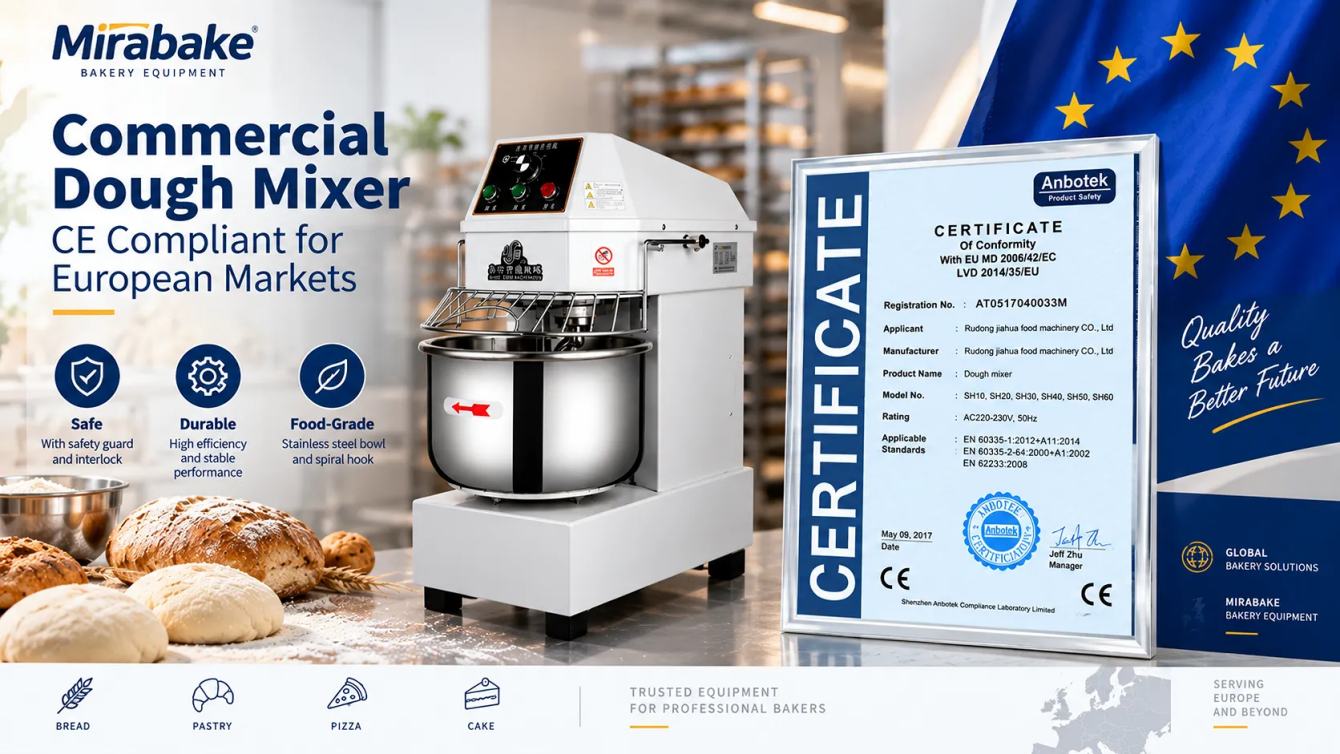

suppliers, selecting a commercial dough mixer involves much more than comparing bowl capacity, motor power, and price. Machinery safety, electrical systems, electromagnetic compatibility, food-contact
materials, technical documentation, and long-term service support can all influence whether equipment is suitable for the European market.
Guangzhou Mirabake Equipment Co., Ltd. is a China-based commercial bakery equipment
manufacturer supplying commercial dough mixers and supporting bakery machinery for
professional food-production applications. For European B2B buyers, Mirabake focuses on integrating applicable safety requirements, manufacturing quality control, food-contact material considerations,
and market-specific equipment configurations into its production and export process.
Understanding these requirements is especially important for European importers and distributors,
because CE marking is not simply a marketing label. Buyers should evaluate the applicable regulatory framework, verify model-specific documentation, and confirm that the equipment configuration is
appropriate for its intended market and application.
What European Buyers Need to Know About CE Compliance for Commercial Dough Mixers
Commercial dough mixers combine moving mechanical components, electric motors, control systems, and food-contact parts. As a result, equipment intended for the European Union may need to address several areas of EU product safety and conformity legislation, depending on the specific machine and configuration.
The European machinery regulatory framework is also undergoing an important transition. Machinery Directive 2006/42/EC remains relevant during the current transition period, while Regulation (EU)
2023/1230 on machinery becomes applicable from 20 January 2027, replacing the existing Machinery Directive framework.
For manufacturers, importers, and distributors, this transition makes it increasingly important to
evaluate machinery safety requirements, risk assessments, technical documentation, and conformity procedures during equipment procurement.
Other regulatory areas that may be relevant to commercial dough mixers include the Low Voltage
Directive 2014/35/EU, the Electromagnetic Compatibility Directive 2014/30/EU, and applicable EU requirements for materials and articles intended to come into contact with food.
The exact requirements depend on the machine design, electrical configuration, intended application, and market in which the equipment will be placed.
EU Regulatory Areas B2B Dough Mixer Buyers Should Evaluate
Rather than treating CE marking as a single certificate, professional buyers should evaluate the different technical areas that can affect commercial dough mixer conformity.
1. Machinery Safety
Commercial spiral dough mixers operate with rotating bowls, spiral hooks, transmission components, and motors capable of generating substantial mechanical force.
Appropriate machinery safety design may therefore include protective guards, safety interlocks,
emergency stopping functions, accessible control systems, and measures designed to reduce exposure to moving components and potential pinch points.
Risk assessment is an important part of this process because the safety solution should reflect the actual hazards presented by the specific machine.
2. Electrical Safety
Commercial bakery equipment frequently operates for extended periods in demanding environments. Electrical components therefore need to be appropriately designed for the machine's intended voltage, frequency, operating conditions, and market.
B2B buyers should evaluate areas such as wiring, electrical protection, control components, motor specifications, insulation, grounding, and applicable electrical documentation.
For international procurement, buyers should also confirm whether the supplied machine matches the electrical infrastructure of the destination market.
3. Electromagnetic Compatibility
Commercial dough mixers contain electric motors and electrical control components that may be subject to applicable electromagnetic compatibility requirements.
Where relevant, buyers should verify that the machine has been evaluated according to the appropriate EMC requirements and that supporting documentation corresponds to the actual equipment model
being purchased.
4. Food-Contact Materials
Mixing bowls, dough hooks, and other components that come into direct contact with dough or ingredients require particular attention.
Commercial buyers should verify the materials used in these components and request relevant
supporting information where necessary. Food-grade stainless steel is commonly used for commercial mixing components because of its corrosion resistance, cleanability, and suitability for repeated food- production cycles.
Material selection should be evaluated together with the intended food application and applicable European food-contact requirements.
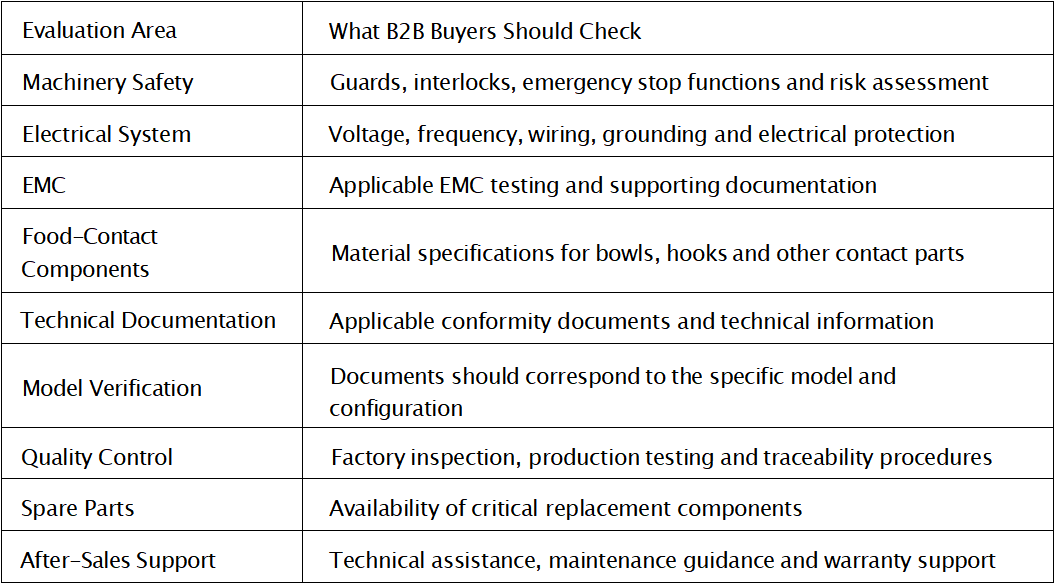
CE Compliance Checklist for Commercial Dough Mixer Buyers
European importers and distributors can use the following checklist when evaluating a commercial dough mixer manufacturer:
This type of verification helps buyers move beyond general claims and evaluate whether a supplier can support long-term commercial equipment procurement.
How Mirabake Integrates Safety and Quality into Dough Mixer Manufacturing
Meeting European market expectations requires more than adding safety components after a machine has been assembled. Safety, material selection, structural stability, electrical configuration, and quality control should be considered throughout the manufacturing process.
Mirabake operates a commercial food machinery manufacturing facility in Guangzhou, China, supporting the production of dough mixers and other bakery equipment for international B2B customers.
Precision machining and controlled assembly are important parts of commercial mixer manufacturing. Internal transmission components, drive systems, shafts, frames, and mounting structures require
accurate processing to support stable operation during repeated commercial workloads.
During production, dimensional inspection and assembly checks can help identify alignment issues
before finished machines proceed to operational testing. Stable mechanical alignment is particularly important for commercial dough mixers because repeated high-load operation can place considerable stress on transmission and structural components.
Material selection is equally important. Mirabake uses food-grade stainless steel for key food-contact components according to product configuration, including mixing bowls and relevant mixing
attachments. Non-food-contact structural components are designed with durability and corrosion resistance in mind for commercial bakery environments.
The final material specification and machine configuration should always be confirmed according to the selected model and destination-market requirements.
How European Importers Can Verify a Dough Mixer Supplier
For European distributors and commercial kitchen equipment importers, supplier due diligence should be completed before placing a wholesale order.
A professional evaluation should focus on both documentation and actual manufacturing capability.
Verify Model-Specific Documentation
Buyers should request applicable technical and conformity documentation for the exact model under consideration.
A general company certificate or documentation belonging to another product does not necessarily demonstrate that the purchased mixer configuration meets the relevant requirements.
Where applicable, buyers should review documents such as:
• Declaration of Conformity
• Relevant test reports
• Electrical information
• Product specifications
• Risk assessment information
• Operating and safety instructions
• Food-contact material information
The documentation required will depend on the product, configuration, and applicable regulatory framework.
Evaluate Test Reports Carefully
Where third-party testing has been performed, buyers should verify that the report identifies the relevant product model and applicable testing standards.
Rather than relying only on the presence of a CE logo, professional procurement teams should evaluate whether the supporting technical evidence corresponds to the actual equipment being imported.
Review Factory Quality-Control Capability
Compliance documentation alone does not guarantee consistent mass production.
For distributors purchasing multiple units, factory quality control is particularly important. Buyers should evaluate whether the manufacturer maintains defined procedures for incoming materials, assembly
inspection, electrical testing, operational testing, and final inspection.
Product traceability, spare-parts availability, and after-sales technical support should also be considered because these factors can directly influence warranty management and long-term distributor
relationships.
Applying Safety and Performance Requirements: Mirabake SH Series Spiral Dough Mixers
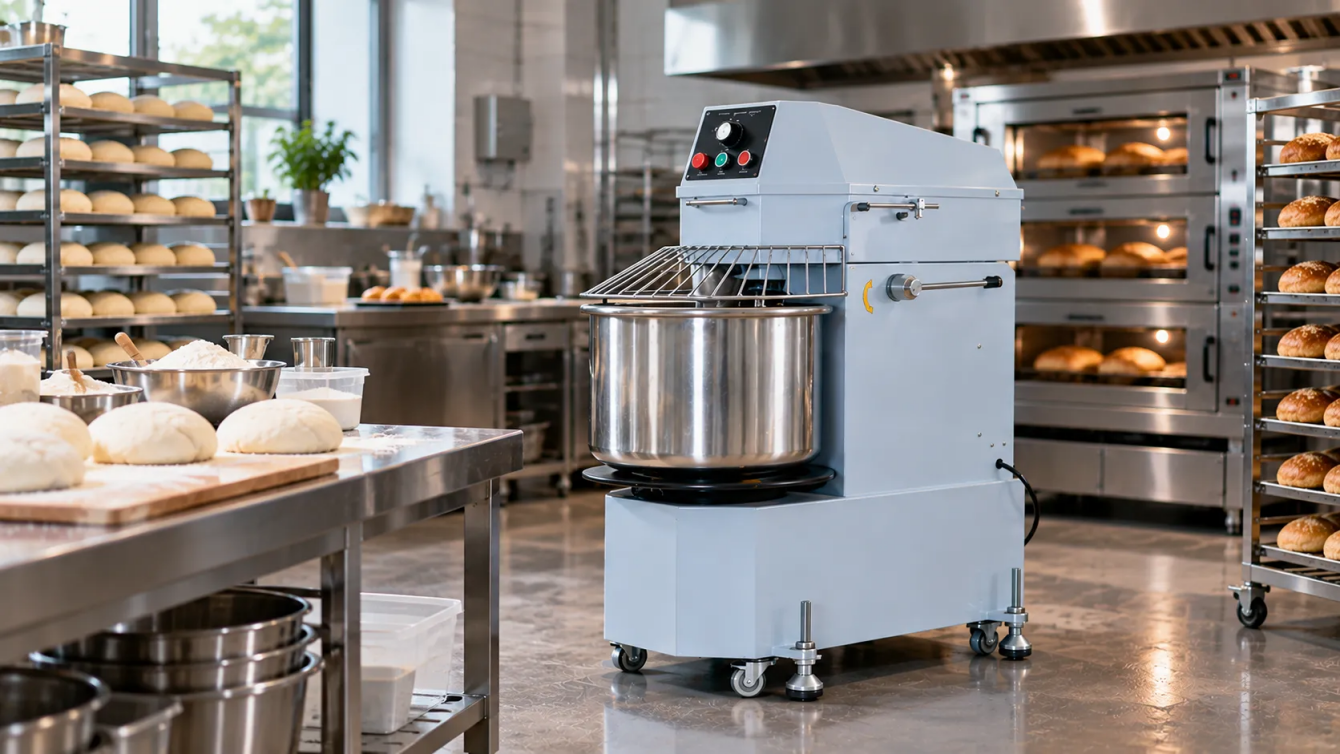
The Mirabake SH Series provides a practical example of how commercial mixer performance and operator safety can be integrated into a professional bakery machine.
The series includes multiple capacities designed for different production requirements, ranging from compact commercial operations to higher-volume bakery and pizzeria applications.
Models within the series include SH20, SH30, SH40, SH50, and SH60, giving B2B buyers different capacity options according to batch size and production volume.
The SH Series uses a dual-speed mixing configuration. Depending on the specific model and
configuration, this approach allows operators to select appropriate mixing conditions for different stages of dough development.
For example, the SH60 is designed for high-volume commercial dough production. The series can provide bowl speeds of 13 or 25 RPM and spiral hook speeds of 125 or 250 RPM, supporting different mixing
requirements during commercial bakery production.
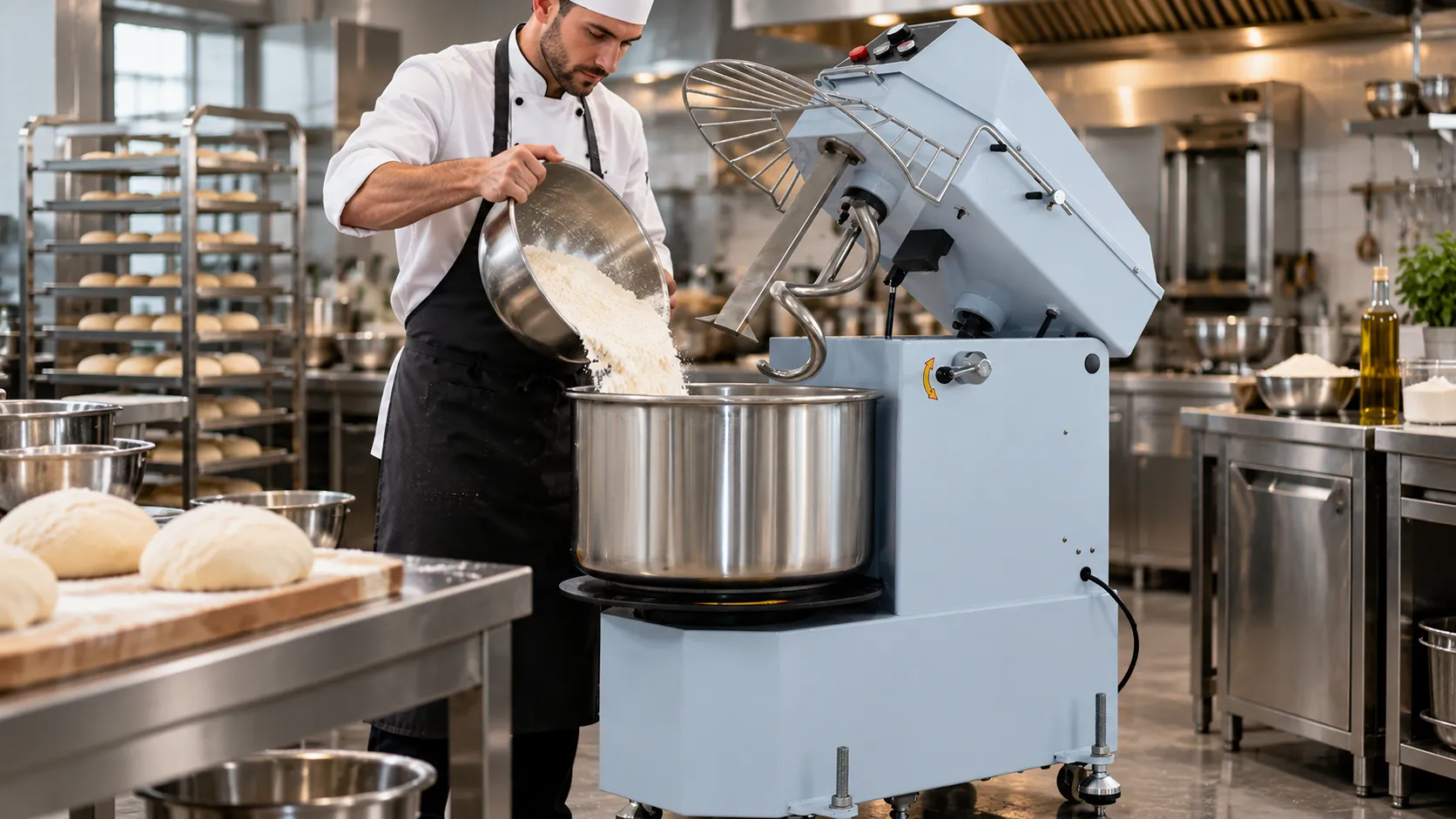
A stainless-steel safety guard helps separate the operator from moving mixing components during
operation. An integrated safety interlock is designed to stop operation when the guard is raised, helping reduce operator exposure to the rotating bowl and mixing hook.
Electrical configurations can also vary according to project requirements. For European procurement projects, buyers should confirm voltage, phase, frequency, plug type, electrical protection, and
applicable conformity documentation before ordering.
Choosing the Right Commercial Dough Mixer for European Bakery Production
CE-related considerations are only one part of commercial dough mixer procurement. The machine must also match the buyer's actual production requirements.
Before selecting a model, commercial bakeries and distributors should evaluate:
• Daily production volume
• Dough batch size
• Flour capacity
• Dough hydration
• Mixing speed requirements
• Motor power
• Bowl capacity
• Single-phase or three-phase power supply
• Available installation space
• Safety requirements
• Cleaning and maintenance requirements
• Spare-parts availability
A small artisan bakery, for example, may prioritize compact dimensions and flexible batch sizes, while a central bakery producing hundreds or thousands of products per day may require greater capacity,
higher-duty components, and more intensive production capability.
For distributors, maintaining several capacity options can also help serve different customer segments within the European bakery and foodservice market.
OEM and ODM Commercial Dough Mixer Solutions for European Distributors
European equipment distributors frequently require more than a standard factory model.
Branding, electrical configuration, control systems, product appearance, packaging, documentation, and other specifications may need to be adapted for individual markets.
Mirabake provides OEM and ODM commercial bakery equipment services for distributors, importers, equipment brands, commercial kitchen suppliers, and project contractors.
Depending on the project and order requirements, customization may include:
• Voltage and frequency configuration
• Single-phase or three-phase options
• Machine branding
• Logo customization
• Exterior appearance
• Control configuration
• Packaging
• Product documentation
• Selected mechanical specifications
For private-label distributors, this manufacturing flexibility can help develop product lines adapted to
local market positioning while maintaining a consistent supply relationship with the original equipment manufacturer.
Why Factory Capability Matters for European B2B Procurement
For commercial bakery equipment buyers, selecting a supplier should not be based solely on the quotation price.
A long-term supplier relationship depends on the manufacturer's ability to provide consistent production quality, technical communication, documentation support, spare parts, and stable delivery.
This is especially important for European distributors because equipment performance after sale can directly affect warranty costs, customer satisfaction, and brand reputation.
When comparing commercial dough mixer manufacturers, procurement teams should therefore evaluate:
Product Performance → Safety → Documentation → Manufacturing Capability → Quality Control → Customization → Spare Parts → Technical Support → Total Cost of Ownership
This broader evaluation provides a more reliable basis for long-term procurement than comparing unit prices alone.
Partnering with Mirabake for European Commercial Bakery Equipment Projects
European commercial bakery equipment procurement requires a balance between performance, safety, applicable regulatory requirements, manufacturing consistency, and long-term supplier support.
For importers and distributors, evaluating CE-related documentation is therefore only one stage of
supplier selection. Factory capability, quality control, model-specific specifications, spare-parts support, and OEM flexibility should also form part of the purchasing decision.
As a China-based commercial bakery equipment manufacturer, Guangzhou Mirabake Equipment Co., Ltd. supplies commercial dough mixers and supporting bakery machinery for international B2B
applications. Through OEM and ODM manufacturing, Mirabake works with distributors, importers, commercial kitchen suppliers, bakery businesses, and equipment brands serving different regional markets.
European buyers evaluating commercial dough mixers can contact Mirabake to discuss model specifications, applicable compliance documentation, electrical configurations, OEM/ODM requirements, wholesale orders, and factory quotations.
Website:https://www.mirabake.com/.
FAQs
1. What CE requirements apply to commercial dough mixers in Europe?
The applicable requirements depend on the machine design and configuration. Commercial dough mixers may fall within EU machinery safety requirements and may also need to address applicable electrical, electromagnetic compatibility, and food-contact material requirements.
2. Is CE marking mandatory for commercial dough mixers sold in the EU?
Machinery placed on the EU market must comply with the applicable EU conformity requirements before the CE marking is affixed. Buyers and importers should verify the specific requirements applying to the
machine they intend to purchase.
3. What documents should an importer request from a dough mixer manufacturer?
Depending on the equipment and applicable requirements, buyers may need to review the Declaration of Conformity, relevant test reports, technical specifications, operating instructions, electrical information, and supporting material documentation.
Documents should correspond to the specific machine model and configuration being purchased.
4. What safety features should a commercial spiral dough mixer have?
Common safety considerations include protective bowl guards, safety interlocks, emergency stopping functions, appropriate electrical protection, stable machine construction, and measures that reduce access to moving components.
The required safety design depends on the machine and applicable standards.
5. How can buyers verify food-contact materials?
Buyers can request material specifications and supporting documentation for components that directly contact dough or ingredients. The required evidence should be evaluated according to the machine
configuration and applicable market requirements.
6. What should European buyers check before importing a dough mixer from China?
Buyers should evaluate applicable CE requirements, model-specific documentation, electrical
configuration, food-contact materials, safety systems, factory quality control, spare-parts availability, warranty terms, and after-sales technical support.
Mirabake
Mirabake
Legal Disclaimer:
EIN Presswire provides this news content "as is" without warranty of any kind. We do not accept any responsibility or liability for the accuracy, content, images, videos, licenses, completeness, legality, or reliability of the information contained in this article. If you have any complaints or copyright issues related to this article, kindly contact the author above.
