

Why Factories Keep Fighting the Same Fires: New Book Names Four Forces Behind Recurring Manufacturing Problems
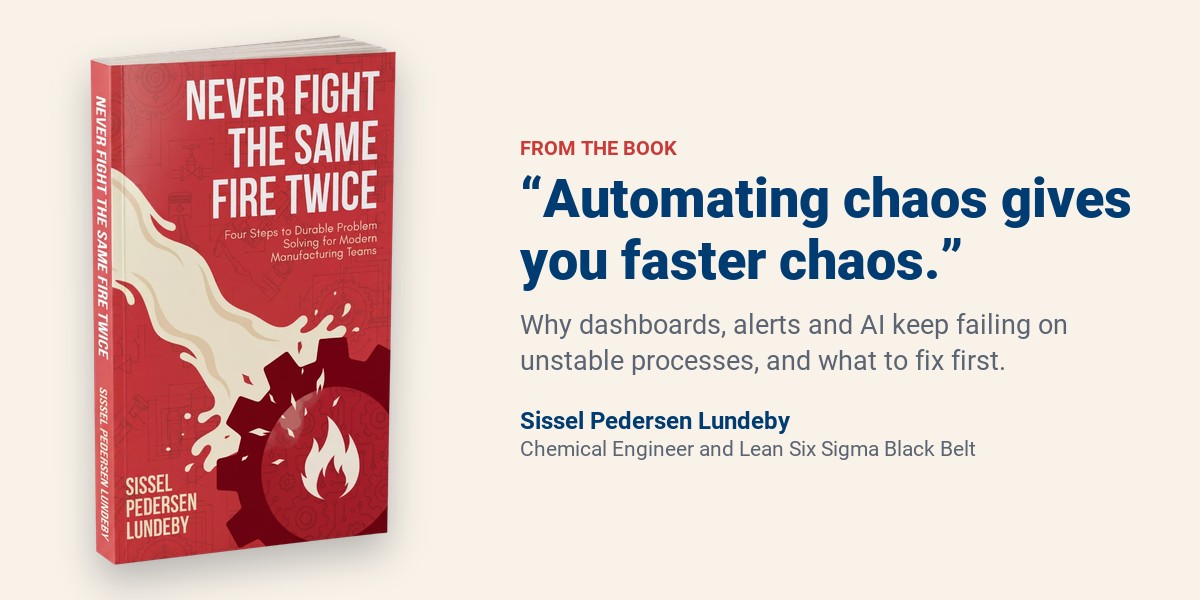
"Automating chaos gives you faster chaos." From Never Fight the Same Fire Twice by Sissel Pedersen Lundeby, on why plants should standardize before they digitalize.
Sissel Pedersen Lundeby's new book names four forces behind recurring problems in manufacturing and argues plants must standardize before they digitalize.
Chemical engineer and Lean Six Sigma Black Belt Sissel Pedersen Lundeby, founder of the Oslo-based consultancy Lean Tech AS, has spent more than 20 years watching that pattern repeat across pharma, defense, food, medical devices and emissions-regulated industries. Her book, Never Fight the Same Fire Twice: Four Steps to Durable Problem Solving for Modern Manufacturing Teams, explains why recurring problems in manufacturing persist and offers a structured alternative for the managers and engineers caught inside them. It reached #1 Best Seller in Amazon's Industrial Production Engineering category in its launch week.
Reexamining the Firefighting Habit
Lundeby does not treat firefighting as a failing of individuals. The book traces the instinct to her family's history as fishermen in Lofoten, Northern Norway, where survival at sea depended on reacting fast. That reflex, she suggests, followed people from fishing boats to factory floors. Fires are satisfying to put out. Prevention is easy to postpone.
The book then identifies four structural forces that keep plants in what Lundeby calls the firefighting loop. Two of them, Busy-ness Mistaken for Progress and The Slide-Deck Consultant, describe activity that looks like improvement without producing it. The other two speak directly to choices manufacturing leaders are making now.
The Problem With Celebrating the Hero
The first is Hero Culture. The person who saves a batch at 3 AM is thanked at the next management meeting, the book observes, while the engineer who redesigned the process so the batch never needed saving goes unnoticed. The organization learns to value speed of response over quality of response, and the people who fight the most fires become the most indispensable.
Lundeby frames this as a system design problem, not a character flaw. When reputation depends on being the fixer, there is little reason to build a process that runs without you.
Standardize First, Then Digitalize
The book's most contrarian argument concerns Digitalization Before Standardization. Lundeby is not opposed to digital tools. Her concern is sequence. She describes dashboards fed by measurement systems nobody has validated, AI models trained on data collected for a different question, and alerts that fire on variation that is normal for the process. Automating chaos, as she puts it, gives you faster chaos, and a polished display creates false confidence that a process is under control.
At a dairy producer, Lundeby exposed $1.1 million a year in raw material waste concealed by the very system meant to measure it. The order she recommends: understand the process, stabilize it, standardize it, then digitalize it.
Followed in that order, the digital layer lasts. At a chemical plant, Lundeby built an energy model with the plant's own people, then handed it over. It predicts consumption across 25 products to within 4%, carried the plant to ISO 50001 certification, and is still maintained by plant staff 12 years later.
Converging on the Right Problem
Underneath the four villains, the book finds one shared failure: capable people working hard on different versions of the problem. Its response is the F.A.S.T. Method: Focus, Analyze, Solve and Track, run in order. The emphasis falls on Focus, where a team agrees on one problem, stated as a measurable deviation, before anyone proposes a fix. The aim is a team that solves its own problems.
Daryl Powell, Chair Professor at USN and co-author of The Lean Sensei, wrote: "Sissel transforms everyday problem-solving from reactive firefighting into deliberate organizational learning."
Never Fight the Same Fire Twice is available on Amazon in Kindle and paperback, and at neverfightthesamefiretwice.com/book. More on Lundeby's work at leantech.no/en and LinkedIn.
Sissel Pedersen Lundeby
Lean Tech AS
sissel@leantech.no
Visit us on social media:
LinkedIn
Instagram
Facebook
Other
Legal Disclaimer:
EIN Presswire provides this news content "as is" without warranty of any kind. We do not accept any responsibility or liability for the accuracy, content, images, videos, licenses, completeness, legality, or reliability of the information contained in this article. If you have any complaints or copyright issues related to this article, kindly contact the author above.
